
Modernization
Modernize your B2B SaaS without the risk of a total rewrite
We help mid-market engineering teams remediate technical debt, scale infrastructure, and transition to cloud-native architectures through phased, incremental execution. Built for SaaS platforms that cannot afford disruption.
Built for Leaders Responsible for Live SaaS Platforms
CTOs modernizing SaaS platforms with active users
Managing platforms serving live customers while addressing accumulated technical complexity and architectural constraints.
Founders scaling beyond early-stage architecture
Transitioning from initial product-market fit to sustainable, scalable infrastructure as customer demands increase.
Teams inheriting legacy SaaS systems with growing complexity
Taking ownership of established platforms where original architecture decisions no longer align with current requirements.
Organizations under pressure to improve reliability without outages
Balancing operational stability with the need for architectural improvements and feature delivery.
The Duskbyte Incremental Framework
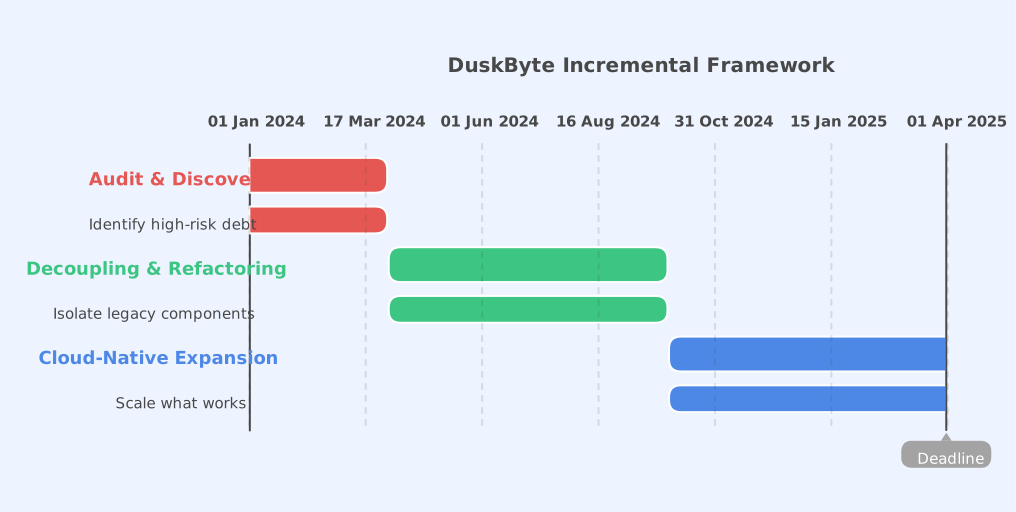
Why Enterprise SaaS Modernization Is Hard
Modernizing live SaaS platforms is constrained by operational realities that cannot be ignored:
- Legacy SaaS systems powering critical customer workflows
- Tightly coupled data models and third-party integrations
- Security, compliance, and regulatory requirements
- Low tolerance for downtime or failed releases
- Established customer contracts and service level agreements
Most modernization failures result from underestimating complexity and operational risk, not from lack of effort or intent. Systems that have supported real customer operations for years carry assumptions that neither the current team nor the original architects fully understand.
What Enterprise SaaS Modernization Means
Enterprise SaaS modernization is not:
Not a rewrite
Complete system replacement introduces unacceptable risk
Not a rushed cloud migration
Infrastructure changes without architectural planning create new problems
Not a tooling upgrade
Technology updates alone do not address systemic architectural issues
Enterprise SaaS modernization is:
Phased architectural evolution
Incremental changes with validation at each step
Backward-compatible change
Preserving existing functionality while improving underlying structure
Designed for live production systems
Every change accounts for active users and operational continuity
Common Modernization Challenges
Enterprise SaaS modernization typically addresses one or more of these challenges
- Reducing technical debt without slowing feature delivery
- Modernizing data models and integration patterns
- Migrating to cloud environments safely and cost-effectively
- Improving system reliability and observability
- Introducing automation or AI capabilities responsibly
- Scaling infrastructure for growing transaction volume
- Maintaining security posture during architectural changes
How We Approach SaaS Modernization
Assessment before action
Comprehensive analysis of current architecture, dependencies, and risk factors before proposing changes.
Phased, incremental change
Small, validated steps rather than large-scale transformations that increase operational risk.
Rollback-safe delivery
Every deployment designed with explicit rollback procedures and validation checkpoints.
Stabilization before acceleration
Ensuring system stability and team confidence before introducing additional complexity.
This approach signals outcome velocity. We guarantee understanding over order, stability over speed, and informed priorities to drive modernization decisions.
Where This Applies
Multi-tenant enterprise SaaS platforms
Systems serving multiple business customers with data isolation, permission complexity, and uptime requirements.
Integration-heavy SaaS ecosystems
Platforms with numerous third-party dependencies, webhooks, and API contracts that constrain change.
Data-intensive SaaS products
Applications where data integrity, migration complexity, and query performance are critical factors.
Regulated or compliance-sensitive environments
Systems subject to SOC 2, HIPAA, GDPR, or other regulatory frameworks that govern technical changes.
Many engagements operate under NDA.
Outcomes You Can Expect
Well-executed SaaS modernization produces measurable operational improvements:
- Reduced operational and delivery risk
- Fewer production incidents and escalations
- Improved platform stability and performance
- Clearer architectural boundaries and documentation
- Confidence in future development decisions
- Better alignment between technical capabilities and business objectives
Frequently Asked Questions
What is enterprise SaaS modernization?
Enterprise SaaS modernization is the systematic improvement of live software platforms through architectural evolution, infrastructure upgrades, and process maturity, executed in phases designed to minimize operational risk while serving active users.
How do you modernize SaaS without downtime?
Through backward-compatible changes, incremental deployment strategies, feature flags, database migration patterns that support both old and new schemas simultaneously, and comprehensive rollback procedures tested before production deployment.
Is SaaS modernization the same as cloud migration?
No. Cloud migration is moving existing systems to cloud infrastructure. SaaS modernization addresses architectural patterns, data models, and operational practices. Cloud migration may be one component of a modernization effort, but they are not equivalent.
When should SaaS modernization be delayed?
When the platform is unstable, when the team lacks operational capacity, during critical business periods, or when the rationale for change is unclear. Modernization should begin from a position of stability, not crisis.
How long does SaaS modernization take?
It depends on platform complexity, team capacity, and scope. Most meaningful modernization efforts span months to years. Quick timelines often indicate insufficient planning or scope reduction that limits impact.
Start With Clarity
Modernizing an enterprise SaaS platform works best when it begins with understanding the system, not rushing to change it.